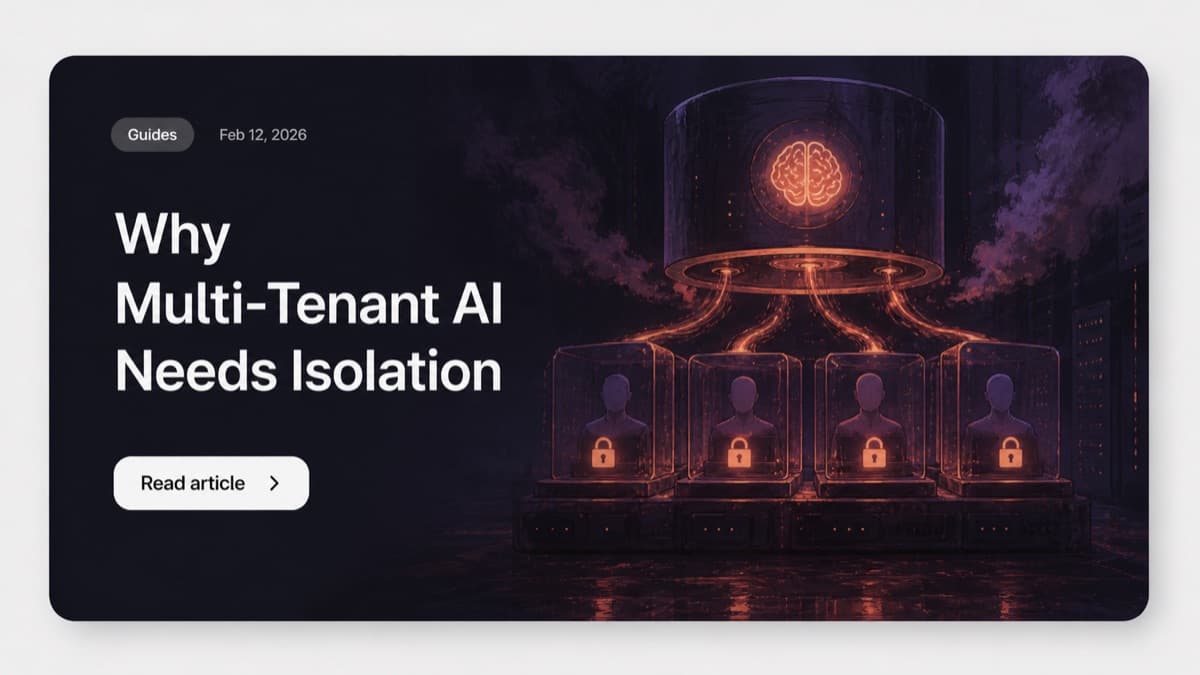
short answer: multi-tenant AI needs isolation because a shared runtime has no wall between customers. one tenant's prompt injection, resource spike, or leaked env var becomes everyone's problem. per-tenant isolation — own container, own volume, own secrets — keeps each customer's blast radius inside their own runtime.
heres how that plays out in practice.
you ship an AI product. ten customers sign up. everything works great.
customer eleven sends a prompt that crashes the runtime. now all ten customers are down too.
thats what happens when you run a shared AI runtime. and honestly it gets way worse than that.
what goes wrong on a shared AI runtime?
most teams start with one AI runtime shared across all tenants. makes sense right? one container, one endpoint, one set of env vars. ship it and move on.
except "ship it and move on" turns into "debug it at 3am" the second your tenants start doing real work.
heres what goes wrong and i see this constantly:
prompt injection crosses tenant boundaries. tenant A crafts a prompt that messes up the runtime behavior, tenant B inherits that broken state. shared runtime means theres literally no wall between them. ive seen this happen more times than i can count, and it usually surfaces right around 50 customers.
resource contention kills performance. one tenant running heavy workloads starves everyone else. your best paying customer gets slow responses because some free tier user is hammering the API. not a great look.
secrets leak. env vars, API keys, model configs — in a shared runtime one misconfigured endpoint can expose tenant Bs secrets to tenant A. this isnt theoretical btw. it happens. ive seen it.
cant customize per tenant. different customers need different model versions, different system prompts, different rate limits. shared runtime forces everyone on same config. good luck explaining that to your enterprise prospect.
isolation isnt some nice-to-have. its table stakes.
when each tenant gets their own runtime every single one of these problems goes away.
no cross-tenant contamination. tenant As prompt injection stays in tenant As container. it crashes? only they go down. everyone else keeps running like nothing happened.
dedicated resources. each tenant gets own CPU, memory, storage. no noisy neighbors. performance is actually predictable for once.
secrets stay secret. each container has its own env vars. tenant A literally cannot access tenant Bs config. the isolation is at infrastructure level not application level. huge difference.
per-tenant customization. different model versions, system prompts, rate limits, feature flags per customer. configure each runtime independently. enterprise customers love this.
the real cost of "well isolate later"
teams skip isolation cuz it seems expensive. more containers more infra more complexity.
but the cost of NOT isolating is way higher.
one data leak and you lose customer trust permanently. not temporarily. permanently. one cross-tenant crash and your SLA is meaningless. one noisy neighbor incident and your enterprise prospect walks out the door.
the companies winning in multi-tenant AI right now? theyre the ones that treated isolation as day-one requirement. not a someday optimization.
how ShipClaw handles this
ShipClaw provisions one isolated OpenClaw runtime per customer automatically. no manual work.
each customer gets:
- their own Docker container with dedicated compute
- a persistent volume at
/datafor state that survives restarts - isolated environment variables for API keys, model config, secrets
- unique URL at
slug.agents.shipclaw.iowith automatic SSL - independent scaling so one tenants usage never touches another
you dont write Dockerfiles. you dont manage kubernetes manifests. you drag nodes onto a canvas, connect them, deploy. thats it. (the 3-step walkthrough covers the whole flow.)
visual builder handles the topology. platform handles the isolation. and if youre weighing building this yourself, run the DIY cost math first.
bottom line
shared AI runtimes are a shortcut that creates long-term liability. per-tenant isolation is the only architecture that actually scales safely.
if youre building AI product for multiple customers, isolation isnt a feature. its a requirement. full stop.